Alexander ‘Greek’ Thomson
 John Thomson, a bookkeeper at the Carron Iron Works (pictured right courtesy of Falkirk Museums), resigned from his post, because Sunday work was contrary to his religious beliefs, secured a position with the Ballindalloch Company and settled down with his second wife and family – including eight children from his previous marriage – in Endrick Cottage at the foot of the village.
Over the years the family increased with the arrival of five more sons and two daughters until the birth of Alexander in 1817. In the following years the family was completed by the addition of two more sons and a daughter.
It was the birth of Alexander, John’s seventeenth child, which makes this event significant, since he was to become an eminent figure in Balfron’s “hall of fame”.
Their idyllic lifestyle was shattered by John’s sudden death in 1824 when Alexander was only seven years old. Most of the family moved to the outskirts of Glasgow. There, however, they were devastated by the deaths of the eldest daughter, three brothers and Alexander’s mother in just three years.
William Thomson, who had stayed on in Balfron as a teacher, moved to Hangingshaw in Glasgow to look after his younger brothers and sisters.
 Alexander, who was plagued by asthma and bronchitis from early childhood, began work, at the age of 12, in a city lawyer’s office. He drew sketches during his free time and when Robert Foote, an architect, visited the office he was so impressed by the drawings that he arranged for Alexander to be apprenticed to John Baird, a fellow-architect. This combination would eventually evolve to become Baird & Thomson (Architects) and then A. & G. Thomson, with Alexander’s brother, George, as partner.
Ill-health also dogged Alexander’s own family some of whom died in early childhood, probably due to the environmental conditions in Glasgow – the Empire’s Second City – at that time. His revolutionary plans for tenement-lined streets with glass ‘arcades’ to dispel the soot, grime and damp never got past the drawing board but the tenements he did build greatly improved the living conditions of the ordinary people of that time.
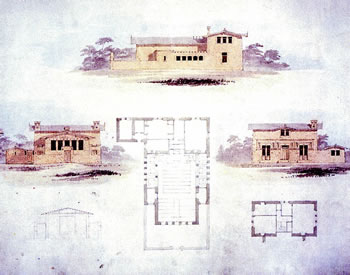
Because of the unique style of his more grand works, Alexander became known as “Greek” Thomson and was responsible for many Glasgow landmarks including the United Free Presbyterian Churches at Caledonia Road and St Vincent Street. His architectural legacy to his native village is the South Manse – “Mansefield” – in Dunmore Street, a typically ‘Thomsonesque’ gravestone in Balfron churchyard and the debatable and untypical house and manse at High Honeyholm, east of the village (See Heritage Research).